Wednesday, 2 November 2016


Tuesday, 1 November 2016
Thrushes in the Mist
Foggy, 10°, light NNE.
Quite a contrast in the weather from yesterday but still a few Ladybirds around.
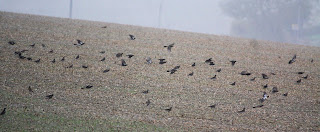
Apart for c500 thrushes out at Lollingdon little else was seen.
Numbers of Fieldfare and Redwing feeding on berries and out in some of the fields.
2 Goldcrest on the north side of the hill and the usual Buntings present, a Sparrowhawk flew over north and a juvenile Mute Swan flew east and a few Siskin around.
A Stonechat seen near the church yesterday and another still out at the Lees. (per Tony Williams).
A Yellow Wagtail reported again between the Waterloo Bridge and garage. (per MA).

Quite a contrast in the weather from yesterday but still a few Ladybirds around.
Apart for c500 thrushes out at Lollingdon little else was seen.
Numbers of Fieldfare and Redwing feeding on berries and out in some of the fields.
2 Goldcrest on the north side of the hill and the usual Buntings present, a Sparrowhawk flew over north and a juvenile Mute Swan flew east and a few Siskin around.
A Stonechat seen near the church yesterday and another still out at the Lees. (per Tony Williams).
A Yellow Wagtail reported again between the Waterloo Bridge and garage. (per MA).
one of the flocks of around 200 Fieldfare and Redwing in the mist.


Harlequin Ladybirds
Am far from an insect person but I have been asked a few questions about Harlequin Ladybirds recently so I thought I would read up on them and put the following short article together.
Man upsets the natural balance again.
The Harlequin Ladybird is one of the most invasive species on planet earth.
They are very variable in their patterning and can be relatively easy to identify but some can be difficult to separate from some native species.
It was introduced from Asia to North America as a biocontrol species against Aphids.
It was originally introduced around 1916 in the US but subsequent introductions then took a foothold in the 1980’s and spread.
They were also introduced in to Europe from the US population for biocontrol around the 1990’s and quickly took a foothold and the species has now spread to most European countries.
They are a large Ladybird and can outcompete our native species and even eat them. It also carries a microsporidian parasite (a fungus) to which it is immune but can fatally infect other species. I think this is the infection that some newspapers are labelling an STD.
Ladybirds have few natural predators, however Swallows and Swifts are immune from their chemical defences as are some Spiders, Parasitic Wasps etc.
A lot more info can be found online.


Man upsets the natural balance again.
The Harlequin Ladybird is one of the most invasive species on planet earth.
They are very variable in their patterning and can be relatively easy to identify but some can be difficult to separate from some native species.
It was introduced from Asia to North America as a biocontrol species against Aphids.
It was originally introduced around 1916 in the US but subsequent introductions then took a foothold in the 1980’s and spread.
They were also introduced in to Europe from the US population for biocontrol around the 1990’s and quickly took a foothold and the species has now spread to most European countries.
They are a large Ladybird and can outcompete our native species and even eat them. It also carries a microsporidian parasite (a fungus) to which it is immune but can fatally infect other species. I think this is the infection that some newspapers are labelling an STD.
Ladybirds have few natural predators, however Swallows and Swifts are immune from their chemical defences as are some Spiders, Parasitic Wasps etc.
A lot more info can be found online.
a few pics of various Harlequins taken over the last few years.


Monday, 31 October 2016
Ladybird, Ladybird fly away!
Hazy sunshine, 16°, light SE.
Most of the Buntings appear to have dispersed but still good numbers of Yellowhammer and Reed Bunting around.
At least 3 Corn Bunting on the hill and 19 Lapwing and 2 Raven over.
Good numbers of Fieldfare and Redwing moving through with 200+ and 50+ respectively and several Song Thrush and a Mistle Thrush in the hedgerows.
A somewhat tantalising view of a rather grey looking Phylloscopus Warbler today that was on show for about 3 seconds about 40 metres away in a garden then disappeared. I searched the periphery for about an hour but the bird did not show again. It could have been a trick of the light but then again it could have been ?
Sparrowhawk, Grey Wagtail and Kingfisher also noted.
Mammals: Roe Deer.
Insects: Other insects noted were a Migrant Hawker, several Common Darter, 2 Brimstone, a few Large/Small White and 3 Red Admiral.


Another walk out to Lollingdon and a warmer day than of late.
The most noticeable thing today was
the amount of Ladybirds around. There were literally hundreds seen flying and
almost every fence post, tree, wall etc. had Ladybirds settled on them, they
even kept landing on me. All but one I identified were Harlequin
Ladybirds.
Most of the Buntings appear to have dispersed but still good numbers of Yellowhammer and Reed Bunting around.
At least 3 Corn Bunting on the hill and 19 Lapwing and 2 Raven over.
Good numbers of Fieldfare and Redwing moving through with 200+ and 50+ respectively and several Song Thrush and a Mistle Thrush in the hedgerows.
A somewhat tantalising view of a rather grey looking Phylloscopus Warbler today that was on show for about 3 seconds about 40 metres away in a garden then disappeared. I searched the periphery for about an hour but the bird did not show again. It could have been a trick of the light but then again it could have been ?
Sparrowhawk, Grey Wagtail and Kingfisher also noted.
Mammals: Roe Deer.
Insects: Other insects noted were a Migrant Hawker, several Common Darter, 2 Brimstone, a few Large/Small White and 3 Red Admiral.


at least 30 Harlequin Ladybird in a stairwell.

Sunday, 30 October 2016
Fungi and Fings
Cloudy, 14°, light ESE.
Loren and I decided on a trip to Wittenham Woods today with a very autumnal feel in the air and reflected in the wood with leaves constantly falling.
Relatively quiet bird wise however 20+ Redwing, several Siskin and Redpoll overhead, a Sparrowhawk and a couple of Goldcrest of note.
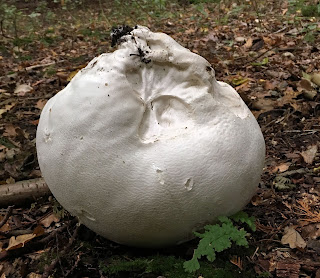
Quite a bit of Fungi on show including a rather large Puffball that we found.
Have not id’d all the fungi yet as I am a bit rusty on that front.
Thanks to Loren for all but one of the pics.


Loren and I decided on a trip to Wittenham Woods today with a very autumnal feel in the air and reflected in the wood with leaves constantly falling.
Relatively quiet bird wise however 20+ Redwing, several Siskin and Redpoll overhead, a Sparrowhawk and a couple of Goldcrest of note.
Quite a bit of Fungi on show including a rather large Puffball that we found.
Have not id’d all the fungi yet as I am a bit rusty on that front.
Thanks to Loren for all but one of the pics.


Friday, 28 October 2016
Stonechat
Mainly cloudy, 15°, light W.
A Stonechat on the hill today and a lot of winter thrushes. Mainly Fieldfare (c300), c50 Redwing, 20’ish Song Thrush and a Mistle Thrush, also good numbers of Starling around, 250+.
The thrushes were mainly feeding today on Haws (Hawthorn) but also on some Sloe berries (Blackthorn) and Yew berries in a garden near the hill.
A Sparrowhawk, Siskin, Chiffchaff, Bullfinch, Kingfisher, Grey Wagtail and the regular 3 species of Bunting, 3 more Finch species, Meadow Pipit and Pied Wagtail etc. also seen.
Golden Plover heard calling after dark from Cholsey Hill area.
2 Nuthatch in the garden again today and a Grey Heron in the meadow.
Mammals: Roe Deer and Brown Hare.
Insects: a single Common Darter and 4 Red Admiral.


A Stonechat on the hill today and a lot of winter thrushes. Mainly Fieldfare (c300), c50 Redwing, 20’ish Song Thrush and a Mistle Thrush, also good numbers of Starling around, 250+.
The thrushes were mainly feeding today on Haws (Hawthorn) but also on some Sloe berries (Blackthorn) and Yew berries in a garden near the hill.
A Sparrowhawk, Siskin, Chiffchaff, Bullfinch, Kingfisher, Grey Wagtail and the regular 3 species of Bunting, 3 more Finch species, Meadow Pipit and Pied Wagtail etc. also seen.
Golden Plover heard calling after dark from Cholsey Hill area.
2 Nuthatch in the garden again today and a Grey Heron in the meadow.
Mammals: Roe Deer and Brown Hare.
Insects: a single Common Darter and 4 Red Admiral.


Wednesday, 26 October 2016
Much as yesterday
Cloudy at first then sunny spells, 14°, light WSW.
Relatively quiet out at Lollingdon today.
Relatively quiet out at Lollingdon today.
2 Raven flew east and several flocks of Fieldfare and Redwing flew over heading south and continued on without stopping.
Still good numbers of Yellowhammer, Reed Bunting, Pied Wagtail, Skylark, Meadow Pipit and Finches (Linnet, Goldfinch and Chaffinch) around.
A couple of Goldcrest on the north side of the hill and at least 2 Bullfinch near the paddock.
Also watched a distant Peregrine chasing Skylarks, did not look as though it was hunting them. It eventually gained height until lost from view.
Insects: a single Common Darter and a couple of Hornet.


Still good numbers of Yellowhammer, Reed Bunting, Pied Wagtail, Skylark, Meadow Pipit and Finches (Linnet, Goldfinch and Chaffinch) around.
A couple of Goldcrest on the north side of the hill and at least 2 Bullfinch near the paddock.
Also watched a distant Peregrine chasing Skylarks, did not look as though it was hunting them. It eventually gained height until lost from view.
Insects: a single Common Darter and a couple of Hornet.


Tuesday, 25 October 2016
More Fieldfares and a Raven
Mainly overcast with a couple of light rain showers, 12°, light SE.
Very much the same out at Lollingdon today although more Fieldfare moving through with upwards of 200 and far lower numbers of Redwing.
A Raven flew north and a Sparrowhawk flew towards the downs.
A Chiffchaff in the garden this afternoon and having said at the week end I had not seen a Nuthatch in the garden for a time. Well there were 2 visiting this afternoon along with several Long-tailed Tit and a couple of Goldcrest.
A Yellow Wagtail still present in the Silly bridge area. (per MA).
Mammals: Stoat and Roe Deer.


Very much the same out at Lollingdon today although more Fieldfare moving through with upwards of 200 and far lower numbers of Redwing.
A Raven flew north and a Sparrowhawk flew towards the downs.
A Chiffchaff in the garden this afternoon and having said at the week end I had not seen a Nuthatch in the garden for a time. Well there were 2 visiting this afternoon along with several Long-tailed Tit and a couple of Goldcrest.
A Yellow Wagtail still present in the Silly bridge area. (per MA).
Mammals: Stoat and Roe Deer.


Monday, 24 October 2016
Fieldfares and Redwings
Overcast, 12°, light ENE.
Well they are here but not stopping. A few hundred winter thrushes today over the hill with most flying south towards the downs, just a few lingered in nearby trees for a time. Both Fieldfare and Redwing, a 60:40 ratio in numbers.
3 Goldcrest on the hill and a slight increase in Pied Wagtail numbers. Apart from that much as last week.
Mammals: Roe Deer.


Well they are here but not stopping. A few hundred winter thrushes today over the hill with most flying south towards the downs, just a few lingered in nearby trees for a time. Both Fieldfare and Redwing, a 60:40 ratio in numbers.
3 Goldcrest on the hill and a slight increase in Pied Wagtail numbers. Apart from that much as last week.
Mammals: Roe Deer.


Subscribe to:
Posts (Atom)