Showing posts with label Pallid Harrier. Show all posts

Tuesday, 10 September 2024

Portland: Day 3

Overcast and rain showers, 16°, blustery W.

A windy day started quietly with not a lot going on. The sea was slow and the windy conditions were suppressing bird movement.

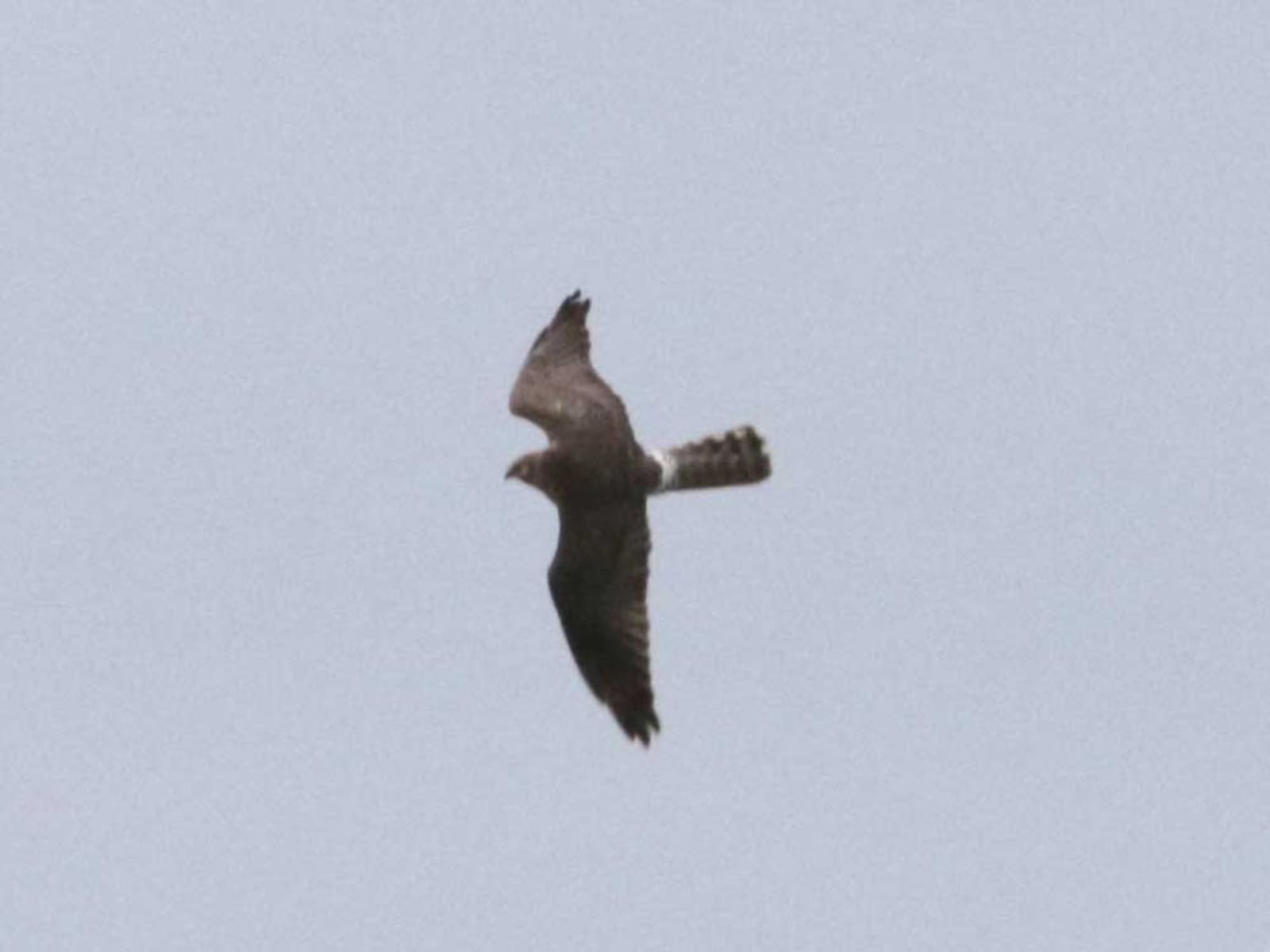
The Marsh Harrier appeared again over the crown estate fields and at around 09:00 another Harrier turned up, all but too briefly but some good photos were taken of it.

The bird then returned about twice more before disappearing for good.

A lot of debate then ensued around it’s ID and was eventually ID’d as a 2nd calendar year male Pallid Harrier.

The day continued windy with some rain later so birding was a little tricky.

The sea produced 35 Manx Shearwater, 3 Balearic Shearwater, 4 Arctic Skua, a Shelduck, c30 Sandwich Tern, c20 Common/Arctic Tern, 20+ Kittiwake, a Common Scoter, etc.

Time spent waiting to see if the Pallid returned was wasted so looking for land migrants was limited with just a couple of Blackcap and Chiffchaff, a few Wheatear and 20+ Swallow.

Mammals: 3-5 Grey Seal were seen on the east side of the bill.

Dragonflies: several Common Darter.

Butterflies: several Small White, 5 Painted Lady, 6 Red Admiral and a number of Speckled Wood.

Pallid Harrier courtesy Martin Cade
Grey Seals. Possibly 2 males vying for the attention of a female.


Marsh Harrier

Sunday, 11 September 2011

Dipping!

This week has been a particularly bad week for most birders in Oxfordshire (good for the county though), 2 firsts (new bird species) for the county and most local birdwatchers have “dipped” them.
“To dip” is a term used in birdwatching, mainly by “twitchers” who travel to see a rare bird and miss it.
I have also come across this term in the forces and it has similar negative connotations.
This past week has seen a Pallid Harrier on Blewbury Down that was seen and photographed by one observer and a Citrine Wagtail at Farmoor reservoir that only stayed for a couple of hours. A handful of lucky observers managed to see the Citrine Wagtail but most “dipped it”.
The emotional side of dipping can be quite severe in some, especially if you have just driven all the way to Aberdeen, caught a flight to Shetland only to find the bird has gone! As well as spending up to £500 on the trip the bird was not seen and the emotion can be very demoralising.
Some people just accept it and hope there will be another one, but others become quite devastated as twitching is a very competitive business.
Most “twitchers” keep a British list, County or Patch list and strive to increase this in either finding their own rare species or travelling, sometimes long distances to see other rare species that have been found. It’s one of those “bloke things” mainly.
I’m the “cup half full brigade”, disappointed but hope another will turn up sometime.

Also yesterday there was some consolation for birders at Farmoor as it also hosted some scarce species for the county, a Little Stint, 3 Black-necked Grebes and a White-winged Black Tern.
I spent approx 5 hours each, looking for the Harrier and Wagtail but saw neither. Fortunately I had seen both species before in the UK but not in my local county. Here’s to the next one!
Well done to both finders of these major rarities in the county.

Pallid Harrier @ http://oxonbirding.blogspot.com/2011/09/pallid-harrier-churn-8th-sept.html

Citrine Wagtail @ http://oxonbirding.blogspot.com/2011/09/farmoor-10th-september.html

Thursday, 8 September 2011

Gulls and a Pallid Harrier (nearby).

Cloudy, 19º, light S.

Out birding today along the Bunk railway and the Thames path, later Cholsey Down, Lollingdon Hill, Churn and Blewbury Down.

Chiffchaffs were frequent today with over a dozen seen/heard, 7 Grey Partridge and the usual Red Kites and Buzzards. Cholsey Marsh had a few Reed Buntings present and a steady passage of Hirundines, 20+ Swallows, 40+ House Martins and 4 to 5 Sand Martins, also 2 Jays.
3 Yellow Wagtails at different locations.

Whilst walking along the river I got a text to say there has been a Pallid Harrier on Blewbury Down (not far from Cholsey). An extremely rare bird in Britain yet alone Oxfordshire.  (This species normal range is southern parts of eastern Europe and Central Asia).

This bird was found and photographed by Roger Wyatt at around 10:00 this morning and confirmed as a juvenile Pallid Harrier (Circus macrourus).

I went on to Cholsey Down and Lollingdon Hill, as I knew other birders were covering the area to the west. Later went to Churn where I joined other birders but unfortunately, the bird was not seen again and presumably, it was a fly through although I feel the area will be searched tomorrow. I left at dusk with Geoff Wyatt. This represents the first record for Oxfordshire for this species.

Whilst on Lollingdon Hill, the field to the south of the hill was being ploughed and was attracting a large number of Gulls. Therefore, I decided to systematically look through them to see what was there.

Around 400 Gulls, most being Lesser Blackback Gulls but also included 2 Herring Gulls, 20+ Black-headed Gulls, 1 Common Gull, 1 Greater Blackback Gull and 2 Yellow-legged Gulls. Nearby but distant were around 500+ gulls in the pig fields and other fields at the foot of Cholsey Downs with gulls moving between areas most of the time.
In addition a Sparrowhawk flew west.

3 Roe Deer seen, a Banded Demoiselle and a Migrant Hawker.


Tawny Owls again in the garden this evening.
   juvenile Pallid Harrier (Circus macrourus). Blewbury Down.


                                  courtesy © Roger Wyatt